How Does A Water Filter Work? Unveiling The Secrets Of Clean and Safe Drinking Water

Safe drinking water is necessary for life and for health. But the water that flows through our taps is often laden with impurities, chemicals, and microscopic contaminants that we cannot see. This is the point where water filters become crucial. Knowledge of how a water filter works will give you a better understanding of why they are necessary and how to make the best choice in regard to the water you enjoy every day.
Understanding The Importance Of Water Filtration
Water filtration isn’t only a taste things, it’s a health thing. Tap water can be chlorinated, containing sediment and heavy metals, bacteria and other foreign substances added during processing or transportation. Prolonged exposure to these impurities can harm you. A water filtration system is a safeguard that guarantees that the water you use to drink, cook, and bathe in daily is cleaner, safer, and healthier for you and your family.
Vital Components Of Water Filters
Multi-stage filtration is the basis of modern water filters to guarantee efficient purification. Each element is designed to eliminate its own particular type of contaminant.
1. Sediment Pre-Filter
The sediment filter is considered the first defense in a water filter system. It filters out large particles from water like sand, dirt, rust , and other debris. By removing these visible contaminants at an early stage, the sediment filter protects the other, more delicate filters and the system from clogging with these particles. This process enhances the clarity of water and the longevity of the system as a whole.
2. Activated Carbon Filter
The purpose of the activated carbon filter is mainly to enhance taste and odor and remove chemical contaminants. It removes chlorine, volatile organic compounds (VOCs), and a number of other potentially harmful substances that are normally present in our tap water, by adsorption. This step greatly improves the odor and taste of the water and makes it more enjoyable to drink and to use daily.
3. Reverse Osmosis (RO) Membrane
The reverse osmosis membrane is one of the most sophisticated parts of a water filtration system. It eliminates tiny impurities on a molecular scale, such as dissolved salts, heavy metals, fluoride, and bacteria and viruses. The RO membrane only allows pure water molecules to pass through, which is why the water is highly purified.
Filtration Process In Motion
Water filtration is a sequential process, with each stage designed to collaborate for the provision of clean and safe water.
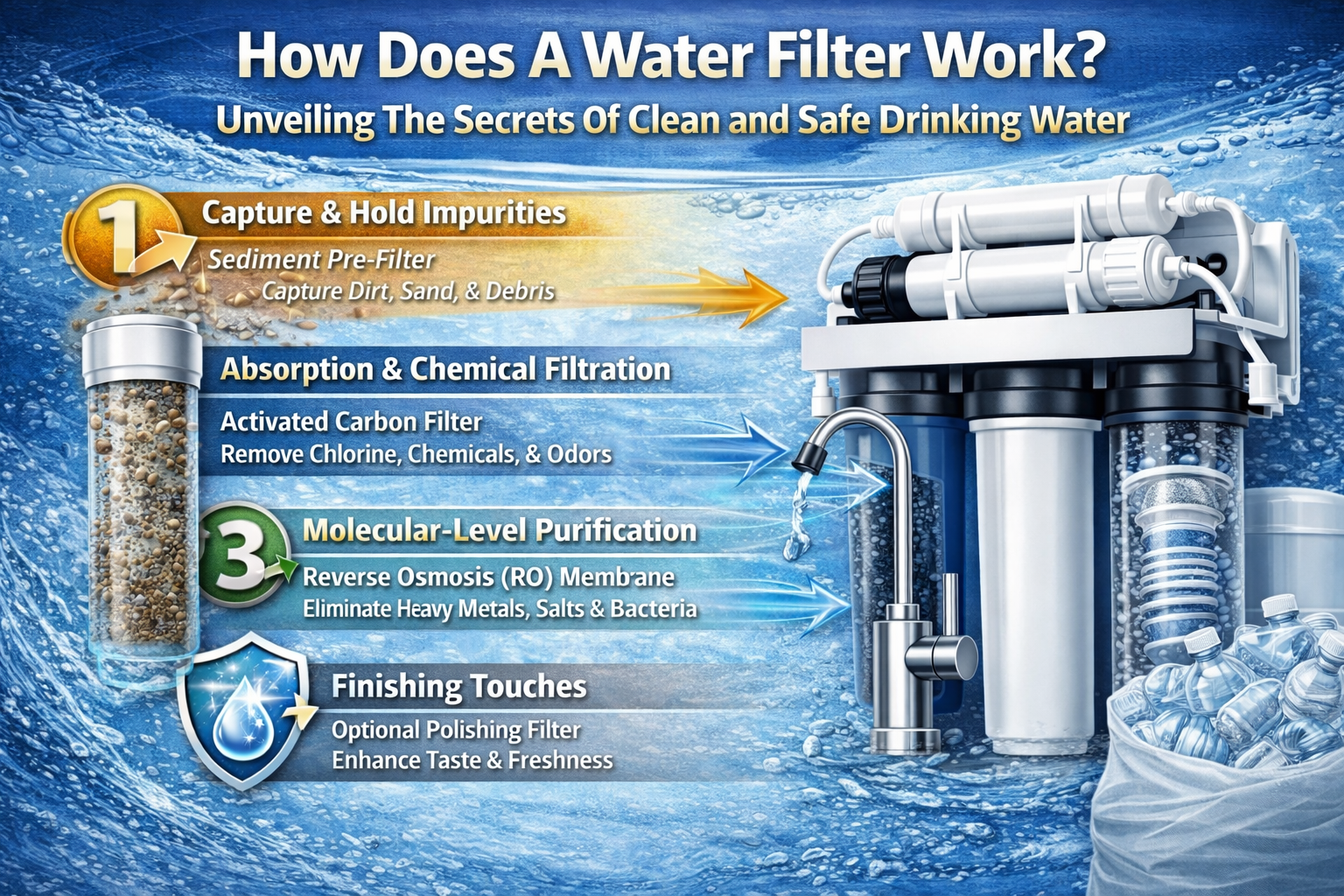
1. Capture & Hold Impurities
As the water flows into the system, the sediment filter catches the large particles and physical contaminants. This prevents dirt and debris from entering the rest of the system and allows the water to flow smoothly through later filtration stages.
2. Absorption & Chemical Filtration
Next, the water goes through an activated carbon filter. Here, chemical impurities like chlorine and harmful organic molecules are absorbed. This procedure makes the water not just safer but also taste and smell better.
3. Molecular-Level Purification
During reverse osmosis, water is pushed through a membrane that is semi-permeable. Pure water molecules are the only molecules that can pass through it, while dissolved solids, bacteria, and other microscopic impurities are rinsed away. It provides the cleanest, purified water possible for drinking.
Finishing Touches
Some systems have optional polishing filters after the main stages of filtration to further improve water quality. These final touches balance taste, clarity, and freshness to ensure your water flow tastes great when it comes out of your tap.
Enhancement Following Purification
Post-filtration adjustments (such as mineral balancing and/or a final carbon filtration) may be necessary. These enhancements enhance the overall drinking experience by adding back beneficial minerals that may have been lost and help to keep the water crisp and refreshing, healthy , and pure with no compromise.
Conclusion
The water purification system employs multi-stage filtering designed to remove the impurities, chemicals, and microscopic contaminants in your water. Whether it’s sediment filtration or high-level reverse osmosis purification, every single component counts when it comes to clean, safe, and tasty water. How water filters work is interesting, and an overview is given below to show you the importance of your water filters and why a good filtration system can be worth the investment when it comes to a healthier life.